On 10 September 2010 the DIV has released a presentation about the ins and outs of the new Belgian licence plates which will use the European format.
Presentation in FrenchPresentation in DutchWhat follows is a personal translation of the presentation in English, with my own comments and details.
1. European licence plate– Historical change
– 7 signs
– Ruby red writing (RAL 3003) on a white ground
– Writing is preceded by the European symbol with twelve yellow stars in a circle and a B symbol on a blue ground.
– Cars and motorcycles alike are concerned by the 1-ABC-123 code (which is unique in Europe)
– 2 licence plate formats are available for cars (rectangular or square)
– Front plate and duplicate: unofficial plate but has similar features
– New registration form
– New registration certificate: A4 format + sand colour
– Starting on 15 November 2010Personal comments
– "historical change" because it is the first time that 7 alphanumeric signs will be used on Belgian licence plates, and because it is the first big change in the licence plate laws since August 2001. Moreover, in time this system is meant to replace the current Belgian licence plate system which started in 1953: all old plates that were still in use will eventually disappear when their owner changes car.
– "Starting on 15 November 2010": this is pretty weird because it's an official annual leave.
2. Registration and format– Rectangular plate:

– Square plate:

Personal comments
– The choice between the rectangular and square formats will be made by the person applying for a registration plate, depending on which licence plate format would suit his/her vehicule best. For instance, a car made in Europe would easily accomodate a rectangular licence plate, while an American car, a truck or certain SUVs would not.
– '1' stands here as the first index digit which will be used. Other index digits for regular plates will be: '2', '3', '4', '5', '6' and '7'. '8' will be used on so-called 'international plates' (meant for EU, NATO and SHAPE personel) and '9' will precede vanity plates. '0' will never be used; actually it is as if plates currently in use were preceded by this index digit (e.g. 631-BSU would count as 0-631-BSU in the DIV database).
– The index number will be followed by a combination of three letters and three digits.
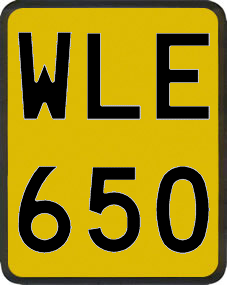
– The three letters group will be a combination of any letters of the Latin alphabet except 'O'. For regular series, the letters A, B, C, D, E, F, G, H, J, K, L, N, P, R, S, T, V, X and Y will be used. It is assumed that the letter I will be skipped as in the former system, while the letters M and W are reserved for motorcycles, Q and U for trailers, O for oltimers and Z for dealers.
– The three digits group will be a combination of any digits except '000'.
– The number of plates possibly issued amounts to: (7 index numbers) x (19 first letters) x (25 second letters) x (25 third letters) x 999 = 7 x 19 x 25 x 25 x 999 = 83,041,875 plates. (NB. This total includes some combinations which will not be issued, such as 'AAP' (ape in Dutch) or 'CUL' (ass in French).) This is utterly silly since there are about 5 to 6 million normal vehicles registred in Belgium and that most people do not have to change licence plates whenever they buy a new car.
3. Licence plate categories3.1. Royal Household, A, E, P
Personal comments
– these four categories of special plates are the only ones which will not be preceded by an index digit.
– Plates for the Royal Household range from 1 to 100. They are used by the members of the Belgian royal family (e.g. 1 for King Albert II, 12 for Queen Fabiola, 43 for Prince Philip) and their servants.
– 'A plates' are reserved for the president of the Representatives' Chamber (A-1), federal ministers and state secretaries (from A-2 – Prime Minister – to A-24), ministers of state (A-25 to A-89), important judges (A-90 to A.110), province governors (A-130 to A-139), cardinals and bishops (A-140 to A-150), chiefs of other recognized religions (A-151 to A-160), chiefs of cabinets, army generals, high civil servants.
– 'E plates' are used by regional ministers and their chiefs of cabinets. They range from E-1 to E-150 approximately. E-1 belongs to Kris Peeters (Minister-president of the Flemish Community), E.2. to Rudy Demotte (Minister-president of the Walloon Region and of the French-speaking Community), E.3 to Karl-Heinz Lamberts (Minister-president of the German-speaking Community), and E-4 to Charles Picqué (Minister-president of the Brussels-Capital Region).
– 'P plates' are used by parliamentarians: P-1 belongs to the president of the Senate, P-2 to the president of the parliament of the French-speaking Community, P-3 to the president of the parliament of the Flemish Community, P-4 to the president of the parliament of the Walloon Region, P-6 to the president of the German-speaking Community; P-10 to P-100 to members of the Senate, P-101 to P-299 to members of the Chamber (with uneven numbers for Flemish members and even numbers for French-speaking members), P-300 to P-499 to members of the parliament of the Flemish Community, P-500 to P-650 to members of the parliament of the Walloon region, P-750 to P-800 to members of the European parliament.
3.2. 'CD' ('corps diplomatique')
Personal comments
– CD plates are used by members of the diplomatic corps, i.e. ambassadors and ambassy personel.
– Although the registration itself does not change (no index digit), the CD letters lose their distinctive green colour.
– Since the registration does not change, it can be assumed that new European plates will start with CD-001E.
– It can be assumed that the issued series will be: CD-…E, CD-…F, CD-…G, CD-…H, CD-…J, CD-…K, CD-…L, CD-…M, CD-…N, CD-…P, CD-…Q, CD-…R, CD-…S, CD-…T, CD-…U, CD-…V, CD-…W, CD-…X, CD-…Y, CD-…Z. (CD-…I and CD-…O are skipped due to the resemblance of I and O with 1 and O, respectively.) Then 20 x 999 = 19,980 plates can be issued. It is possible that the new licence plates law will create a new code, e.g. CD-AA11, CD-AA111 or CD-001AA.
3.3. Q and U plates (i.e. for trailers weighing more than 750 kg)
Personal comments:
– In 2001 trailer plates, starting with QAA-001, were meant to be the first plates featuring the European format and colour: black on white was thought to be the best combination for recognition by speed cameras. This measure was applied to trailers plates only not for the purpose of testing them, but simply because the government did not want to spend too much money on larger, hence more expensive plates; it was assumed that they would cost 100 BEF instead of 50 BEF.
– The registration will consist of an index digit, followed by a three letter group starting with Q or U and excluding the letter 'O' in second and third positions, and followed by a combination of three digits with the exception of '000'.
– The registration will be painted ruby red instead of black.
– While it was possible to include 9 dies on a 2001 trailer plate (space, Q, letter, letter, dash, digit, digit, digit, space), 10 dies can be placed on a 2010 European plate because dies are narrower.
– There will be 7 x 2 x 25 x 25 x 999 combinations, which amounts to 8,741,250 plates in total, or twice that number if the combination 1-123-ABC combination is allowed. This is of course very stupid since there are about half a million trailers registred in Belgium…
3.4. O plates (i.e. for oldtimers)
Changes to the reglementation:
– Vehicles with an O plate remain exempted from annual technical inspection.
– Owners of a vehicle with an 'oldimer statement' which exempts them from annual technical inspection and circulating with a regular plate have to choose before 15 November 2011 if he/she keeps their regular plate with annual technical inspection or asks for an O plate without annual technical inspection.
– Re-registration of an O plate for a regular plate under the name of the same owner is submitted to technical inspection prior to registration.
Personal comments
– The design of the letter 'O' will be slightly modified to make a difference with '0', as shown in the example plate above.
– Registration consists of an index digit (1 to 7) followed by a three letter group starting with O and excluding the letter 'O' in second and third positions, and followed by a combination of three digits with the exception of '000'.
– There will be 7 x 1 x 25 x 25 x 999 combinations, which amounts to 4,730,625 plates in total, or twice that number if the combination 1-123-ABC combination is allowed. Once again, this is totally pointless because about 75,000 oldtimers plates have been issued so far.
3.5. TX and TXL plates
Changes to the reglementation:
– Use of a TX or TXL plate will be mandatory on a vehicle which is used as taxi or which is rented with a chauffeur: it is a regional competence (already obligatory in Wallonia, Brussels and Flanders will follow).
– Given the above-mentioned obligation, the DIV demands that the plate is returned within 8 days after a taxi company or car rental company has ceased trading.
– Additional letter combinations for car rental with chauffeur: TXR and TXV.
Personal comments
– Taxi plates: registration consists of an index digit (1 to 7) followed by a three letter group starting with TX and excluding the letters H, L, O, R and V in third position, and followed by a combination of three digits with the exception of '000'. There will be 7 x 1 x 1 x 21 x 999 combinations, which amounts to 146,853 combinations. This is still unnecessary to have that many combinations because about 5,000 plates have been issued so far.
– Car rental with driver plates: registration consists of an index digit (1 to 7) followed by a three letter group starting with TXH, TXL, TXR and TXV in third position, and followed by a combination of three digits with the exception of '000'. There will be 7 x 4 x 999 = 27,978 plates. Up to now some 2000 plates of this kind have been issued.
3.6. Temporary plates
Personal comments
– Temporary plates are meant for vehicles that are exported abroad.
– On older temporary plates, a sticker and a millesim indicate the month at the end of which the plate ceased to be valid. For instance, the small plate above was valid until 31 October 2009. Red stickers mean that the vehicle was exempted from VAT, while blue stickers mean that VAT was paid.
– Registration consists of an index digit (1 to 7) followed by six numbers starting with 000001. Validity is indicated by a red or blue sticker (VAT exempted or not) and a millesim, on the right side of the plate. In total, 11 digits will be visible on a temporary plate!
– There will be 7 x 999,999 combinations, that is 6,999,993 plates in total. Up to now only a bit more than half a million temporary plates have been issued since 1994 (when the 6 digits temporary plates were first issued).
3.7. International plates, EUR and Eurocontrol

– Toll/VAT validity sticker disappears.
– No vanity plate with index digit 8.
– Fine if the licence plate is no more valid, and no automatic disbarment.
Personal comments
– EUR plates disappear, while they were quite nice-looking. EURO plates disappear. International temporary plates disappear. In short, all blue plates disappear. Diversity disappears. Thanks.
– Registration consists of the index digit 8 followed by a three letter group and a three digit group. The three letter group will probably start with the letters A, B, C, D, E, F, G, H, J, K, L, N, P, R, S, T, V, X and Y, although I would predict that the AEA code will never be reached. The letters M, O, Q, U, W and Z will not be used in first position because they could be used for special series: M and W for motorcycles (e.g. 8-MAW-945 or 8-WIG-136), O for oldtimers (e.g. 8-OAF-469), Q and U for trailers (e.g. 8-QBC-762 or 8-USB-361) and Z for dealers (e.g. 8-ZAF-003), although it would not be very realistic. The letter I would be skipped as in the normal series. The other letters in the three letter group would be all the Latin letters except O due to its resemblance to zero. The three digit group would be anything between 001 and 999.
– There will be 1 x 19 x 25 x 25 x 999 combinations, which amounts to 11,863,125 plates. So far 45,000 international plates have been issued; if we add to that total the 10,000 EUR plates and 1,000 plates, it all comes down to 56,000 plates. Reserving an index digit for international plates is totally pointless.
3.8. Commercial plates
Only in 2010:
– New registration before 15 November 2010 is only valid for year 2010.
– New registration after 15 November 2010: owner receives a new European licence plate with a sticker valid until the end of 2011.
– Lengthening of validity only possible from 15 November 2010 until 31 January 2011 + holder receives a new European licence with a sticker valid until the end of 2011.
– Current fees remain unchanged.
– Lengthenings which lead to the delivery of a new European licence plate are considered to be regular lengthenings as far as fees are concerned.
Personal comments
– If we try to decode what's mentioned above, you'd get something like: people who ask for a dealer plate before 15 November 2010 will get a non-European licence plate with a 2010 validity sticker, implying it will be valid only until 31 December 2010. However, people asking for a dealer plate after 15 November will automatically get a new one in the European format, with a 2011 sticker which will be valid until 31 December 2011.
– You don't have to be Einstein to understand that this validity sticker looks silly where it stands…
– Car dealers (this includes all kinds of vehicles except motorcycles and trailers): registration consists of an index digit (1 to 7) followed by a three letter group and a three digit group. The three letter group starts with the letter Z; the second letter is A, B, C, D, E, F, G, H, I, J, K, L, N, P, R, S, T and V; the third letter is any Latin letter except O. There will be 7 x 1 x 18 x 25 x 999 combinations, which amounts to 3,146,850 plates. Once again, this is way too much in comparison to the approximately 45,000 dealer plates that have been issued since 1997.
– Motorcycle dealers: see below (3.9.).
– Trailer dealers: registration starts with an index digit (1 to 7) followed by a three letter group and a three digit group. The three letter group starts with the letters ZQ or ZU; the third letter is any Latin letter except O. The three digit group ranges from 001 to 999. There will be 7 x 1 x 2 x 25 x 999 combinations, i.e. 349,650 plates. It's worth noting that about 1,000 plates of this kind have been issued by the DIV since 1997.
– Car test plates: registration starts with an index digit (1 to 7) followed by a three letter group and a three digit group. The three letter group starts with the letters ZZ, ZY or ZX; the third letter is any Latin letter except O. The three digit group ranges from 001 to 999. There will be 7 x 1 x 3 x 25 x 999 combinations, i.e. 524,475 plates.
– Motorcycle test plates: see below (3.9)
– Trailer test plates: registration starts with an index digit (1 to 7) followed by a three letter group and a three digit group. The three letter group is either ZZQ, ZZU, ZYQ, ZYU, ZXQ or ZXU. The three digit group ranges from 001 to 999. There will be 7 x 6 x 999 combinations, i.e. 41,958 plates. It can be pointed out that a mere 1,000 plates of that kind have been issued since 1997.
3.9. Motorcycle plates

Personal comments
– Motorcycle plates: registration consists of an index digit (1 to 7) followed by a three letter group and a three digit group. The three letter group starts with M or W and the second and third letters are any Latin letters except O. The three digit group ranges from 001 to 999. There will be 7 x 2 x 25 x 25 x 999 combinations, i.e. 8,741,250 plates. To date about 1,000,000 motorcycle plates have been issued.
– Motorcycle dealers: registration consists of an index digit (1 to 7) followed by a three letter group and a three digit group. The three letter group starts with ZM or ZW and is followed by any letter except O. The three digit group ranges from 001 to 999. There will be 7 x 1 x 2 x 25 x 999 combinations, i.e. 349,650 plates. It's worth noting that about 2,000 plates of this kind have been issued by the DIV since 1997.
– Motorcycle test plates: registration starts with an index digit (1 to 7) followed by a three letter group and a three digit group. The three letter group is either ZZM, ZZW, ZYM, ZYW, ZXM or ZXW. The three digit group ranges from 001 to 999. There will be 7 x 6 x 999 combinations, i.e. 41,958 plates. It can be pointed out that a mere 750 plates of that kind have been issued since 1997.
– Motorcycle temporary plates: no piece of information has been given by the DIV about these plates. It could be inferred that the model would be: an index digit followed by three digits (possibly starting with '9' or '99' as in current series) above three digits.
– International motorcycle plates: given the existence of such plates nowadays (blue on white plates with a registration consisting of two groups of three digits above one another and starting with '98') it is quite likely that international motorcycle plates will be issued. Registration would consist of the index digit 8 followed by a three letter group and a three digit group. The three letter group would start with the letters M or W and would be followed by two Latin letters other than O. The three digit group would range from 001 to 999. There would be 1 x 2 x 25 x 25 x 999 combinations, i.e. 1,248,750 plates, which is absurd since about 2,500 plates of this type have been issued since 2001.
4. Security elements
Personal comments
– The European plate measures 520 x 110 millimetres.
– The edge of the plate is embossed and has a width of 15 millimetres (5 millimetres on each side of the red band, which itself measures 5 millimetres).
– 10 dies of 50 millimetres can be placed on the European plate. The first die is a blank which will be covered by the Belgian euroband. The nine other dies are digits, letters and dashes. Each digit and letter measures 35 x 70 millimetres, except '1' (20 millimetres) and 'I' (9 millimetres) although they occupy a 50 millimetre die. Dashes measure 20 by 9 millimetres. The width of each line is 9 millimetres.
– Each of the four holes in the plate has a diametre of 12 millimetres.
4.1. Embossed sceal (CV)
Personal comments
– 'CV' stands for 'circulation' and 'verkeer', i.e. French and Dutch for 'traffic'.
– The CV sceal is embossed above the first dash. This sceal was previously embossed above the dash which was most on the right: for example, on '3-HR-76' it was embossed between 'R' and '7'.
– It measures 20 by 12 millimetres.
4.2. Securized image with positive identification (Belgian Lion)
Personal comments
– This security hologram with Belgian Lions and the year of manufacture passes across the sixth die (i.e. the 5th sign, which is the middle of the registration, but not the middle of the plate).
– The hologram is only visible if you are close to the plate and from certain angles.
4.3. Visual security thread
Personal comments
– This is a completely new security element.
– This thread is located right to the Belgian euroband. It has a width of 4 millimetres and is 110 millimetres high.
– It features several times the letters 'DIV' (8 mm) and the CV sceal (6,5 mm) (both separated 2 mm from one another) which are slightly engraved.
– Two sinusoidal lines run across the vertical DIV/CV thread.
4.4. DIV sceal
Personal comments
– This DIV sceal is barely visible because it is slightly engraved on the licence plate.
– It was originally introduced in 1999 as of the SAA series.
– It measures 12 by 12 millimetres in total.
– It features the letters DIV above the number 286375 (official manufacturer's reference) and the letter B followed by a dot and the year of manufacture.
– This DIV sceal is located below the first dash, that is under the CV sceal.
5. Licence plate reproductionQuality demands similar to those of the official plate:
– Only one type of aluminium plate EN 1050A or 1200/H42 which is 0.95 to 1.25 mm thick, featuring the manufacturer's identification mark on the reverse side of the plate.
– Signs are to be embossed into the aluminium plate.
– Form and dimension of the signs are defined, accepted tolerance as to width and height: + 2 mm.
– Plate corners are round: tolerance of those rounds: 10 ± 2 mm
– Laminated class 1 retroreflective film on the aluminum plate, featuring the manufacturer's identification mark on the reverse side.
– Minimal retroreflective power, trichromatic data and minimum light factor are defined.
– Free choice between rectangular or square format, no matter which format was chosen for the official plate.
– Plate manufacturers (aluminium + film) are ISO 9001-2008 certified.
6. New registration formNewly added possibilities
– Choice between rectangular and square plate
– Possibility of an express delivery
– Choice of the delivery address (request via WebDIV or DIV parlour).
Personal comments – When you have to register a vehicle after 15 November 2010, you will automatically get a new European licence plate. Vehicles can be registred via WebDIV or one of the 11 parlours of the DIV in Belgium, or via mail. You get to choose between the regular rectangular format or the square format if your vehicle cannot accomodate too long a plate. You can also opt for an express delivery for some extra euros, and you tell the DIV where you want to receive your plate.
7. New registration certificate
Changes that have been made are the following:
– A4 format.
– Sand colour.
– Additional information.
– If a copy is needed, the copy mentions clearly "Not valid for selling nor registrating" in four languages.
– Additional barcodes for "tracking and tracing".
– All the codes comply with the European certificate of conformity and with the concerned European directives.
– The owner's language determines the heading of the registration certificate.
8. Description of the registration procedureRegistration procedure:
– WebDIV: insurance company / leasing company
– Parlours: 11 provincial branches
– Via mail
8.1. WebDIV 8.2. DIV parlours
 8.3. Mail
 9. Transit registration10. Duplicate
Upcoming.